
June 5, 2026
Diagnostic accuracy is the foundation of quality patient care. Yet many pathology laboratories still rely on manual processes that introduce delays, transcription errors, and compliance risks. Smart lab reporting software addresses these challenges directly — automating report generation, integrating data across workflows, and delivering results that clinicians and patients can trust.
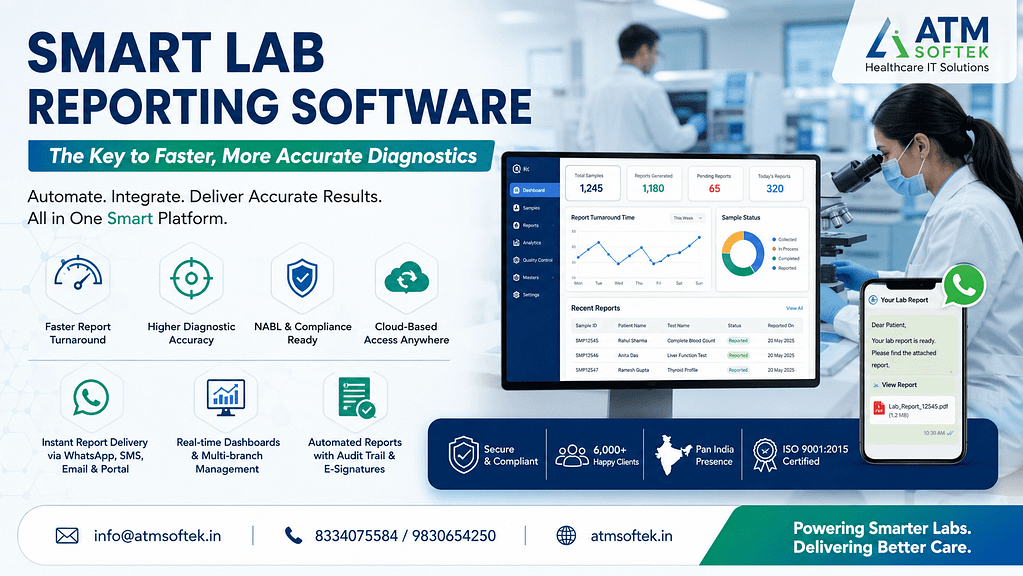
Smart lab reporting software is a category of digital tools designed to streamline the end-to-end process of generating, validating, and distributing diagnostic reports. Built on a laboratory information management system (LIMS) architecture, it connects sample intake, test processing, quality control, and report delivery into a single, auditable workflow.
Modern solutions also incorporate cloud-based lab management software capabilities, enabling multi-branch access, real-time data synchronisation, and remote report review — all without infrastructure-heavy on-premise setups.
Automated lab report generation eliminates manual data entry at every stage. Results from analysers feed directly into the reporting engine, pre-populated templates are applied, and the report moves to the pathologist for review — not to a data entry queue. This compression of time-to-delivery is measurable, often reducing report turnaround by 40–60% in high-volume labs.
Human transcription errors are a primary source of diagnostic inconsistencies. Lab report automation software enforces structured data entry, applies reference range validation, and flags anomalous values before they reach the final report. In digital pathology reporting systems, this is compounded by the ability to attach high-resolution scan images and annotated findings directly to the report, giving referral physicians complete diagnostic context.
NABL-accredited labs carry stringent documentation requirements. A capable laboratory information management system maintains a complete, time-stamped audit trail for every sample — from collection to report dispatch — reducing compliance preparation from days to hours.
Patients increasingly expect digital-first service. Smart lab reporting software enables instant report delivery via WhatsApp, SMS, or patient portals, eliminating the need to collect physical copies. This single change measurably improves patient satisfaction scores across diagnostic centres.
When assessing any platform, prioritise these capabilities:
ATM Softek Private Limited has been building healthcare SaaS solutions since 2012. Headquartered in Kolkata and active across 21 Indian states, it serves over 6,000 clients ranging from independent pathology labs to multi-specialty hospital networks — all backed by ISO 9001:2015 certification.
Its flagship pathology lab software is a fully integrated digital pathology reporting system — combining automated lab report generation, analyser interfacing, NABL-ready audit trails, and instant WhatsApp report delivery in one platform. ATM Softek’s approach to cloud-based lab management software is modular: labs can deploy the full suite or adopt specific modules as operational needs evolve.
For labs considering a shift to smart lab reporting software, ATM Softek offers dedicated implementation support, onboarding training, and a direct support line — reducing time-to-value and minimising operational disruption during transition.
Contact ATM Softek: info@atmsoftek.in | 8334075584 / 9830654250 | atmsoftek.in
The decision to adopt smart lab reporting software is not purely technical — it is operational and strategic. Poorly implemented platforms create new bottlenecks and staff resistance. Evaluate vendors on three dimensions:
Q1: What is smart lab reporting software?
It is a digital platform that automates the creation, validation, and delivery of diagnostic reports within pathology labs and diagnostic centres, typically built on a laboratory information management system (LIMS) framework.
Q2: How does lab report automation software reduce errors?
By eliminating manual data transcription, applying reference range validation automatically, and flagging anomalies before reports are finalised, automation software removes the primary human-error vectors in lab reporting.
Q3: Is cloud-based lab management software secure for patient data?
Reputable platforms employ encrypted data transmission, role-based access controls, and compliance with applicable data protection standards. Always confirm the vendor’s data residency policy and security certifications before deployment.
Q4: What is a digital pathology reporting system?
A digital pathology reporting system combines automated report generation with the ability to attach high-resolution slide images, pathologist annotations, and structured diagnostic findings into a single, distributable report.
Q5: How long does implementation typically take?
For a single-branch lab, implementation of a smart lab reporting software platform typically ranges from two to six weeks, depending on the number of analyser interfaces, report template complexity, and staff training requirements.
Q6: Can this software integrate with existing hospital systems?
Most enterprise-grade platforms support HL7 and FHIR standards, enabling integration with hospital information systems (HIS), electronic medical records (EMR), and billing platforms.