
May 28, 2026
Modern diagnostic and pathology laboratories face mounting pressure to maintain accuracy, regulatory compliance, and operational efficiency simultaneously. As accreditation standards tighten across India, NABL compliant software has emerged as an essential foundation for labs that want to not only meet regulatory requirements but genuinely improve patient outcomes. Rather than treating compliance as a checkbox exercise, forward-thinking labs now use it as a platform for quality-driven growth.
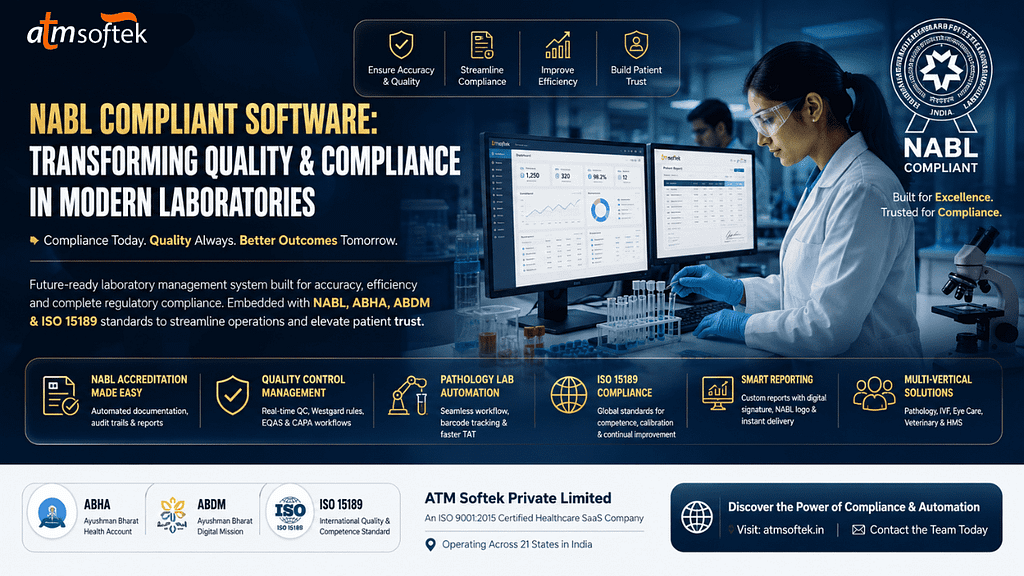
NABL compliant software refers to laboratory management systems specifically designed to align with the National Accreditation Board for Testing and Calibration Laboratories (NABL) standards — the Indian equivalent of international frameworks for medical laboratories. These systems embed quality requirements directly into daily lab workflows, so compliance becomes an outcome of normal operations rather than a separate administrative burden.
Furthermore, leading solutions like ATM Softek go beyond NABL by integrating ABHA (Ayushman Bharat Health Account), ABDM (Ayushman Bharat Digital Mission), compliance into a single unified platform — making them comprehensive healthcare laboratory management systems for the modern Indian healthcare ecosystem.
One of the most immediate benefits of NABL accreditation software is its ability to drastically reduce manual documentation. Traditionally, labs spend enormous time compiling audit trails, maintaining standard operating procedures, and preparing for assessments. With the right system, all of this happens automatically in the background.
ATM Softek’s laboratory management software, for instance, structures every workflow around audit-readiness. It captures data at each stage, logs personnel actions, timestamps results, and organises documentation into accreditation-ready formats. Consequently, when an assessment team arrives, the lab manager simply exports the required reports rather than scrambling to compile records from disparate sources.
Accuracy in diagnostic testing is non-negotiable. A robust quality control management system within NABL compliant software enforces internal quality checks at every critical step — from sample receipt through result validation. The system flags anomalies, alerts technicians to out-of-range calibration results, and prevents results from progressing through the workflow until quality checks pass.
Additionally, integration with external quality assessment schemes (EQAS) becomes seamless, as the software automatically captures participation data and generates corrective action records when performance deviates. This level of systematic oversight significantly reduces the risk of diagnostic errors.
Pathology lab automation is no longer optional for labs that handle high test volumes. Modern laboratory automation connects analysers, barcode scanners, and reporting modules so samples move through the lab with minimal manual intervention. Results feed directly into the lab reporting software, which formats and delivers reports to clinicians or patients through integrated portals.
Moreover, automation reduces transcription errors, speeds up turnaround times, and frees technical staff to focus on interpretation and exception handling rather than data entry. Labs that implement automation consistently report measurable gains in both throughput and staff satisfaction.
ATM Softek serves pathology labs, eye care centres, IVF laboratories, veterinary clinics, and hospital management systems. Across all these verticals, medical laboratory compliance requirements share common threads: structured documentation, validated processes, traceable results, and demonstrable continual improvement.
Because ATM Softek builds NABL, ABHA, and ABDM compliance into the core architecture of its products rather than bolting them on as optional modules, compliance scales with the lab rather than becoming a bottleneck as test volumes grow.
ATM Softek Private Limited, a certified healthcare SaaS company based in Kolkata, operates across 21 Indian states. Its product suite covers the full spectrum of healthcare laboratory management — from pathology and HMS to IVF and veterinary software. Critically, all products carry integrated NABL, ABHA, and ABDM compliance, positioning them as truly future-ready solutions for Indian healthcare providers.
Beyond accreditation, ATM Softek’s lab reporting software generates professional, customisable patient reports with digital signature support, NABL logo integration, and direct WhatsApp/email delivery — closing the loop between lab operations and patient communication.
What is NABL compliant software?
NABL compliant software is a laboratory management system designed to meet the standards set by the National Accreditation Board for Testing and Calibration Laboratories. It automates documentation, quality control, and audit-readiness processes so that labs can maintain accreditation with less manual effort. Solutions like ATM Softek extend this further by also covering ABHA and ABDM compliance within a single platform.
How does NABL accreditation software help laboratories?
NABL accreditation software embeds compliance requirements into routine lab workflows. It captures audit trails automatically, manages standard operating procedures, schedules internal audits, and generates accreditation-ready documentation on demand. As a result, labs reduce preparation time significantly and sustain compliance between formal assessments rather than only during them.
What are the key features of laboratory management software for quality control?
Key features include integrated quality control management with automated Levey-Jennings charts and Westgard rule enforcement, external quality assessment scheme tracking, corrective and preventive action (CAPA) workflows, equipment calibration scheduling, personnel competency records, and sample traceability from collection through reporting. ATM Softek incorporates all of these within its unified healthcare laboratory management system.
How does pathology lab automation improve lab efficiency?
Pathology lab automation connects analysers, barcode systems, and reporting software so samples progress through the laboratory with minimal manual handling. This reduces transcription errors, shortens turnaround times, and allows skilled staff to focus on interpretation rather than data entry. Labs that adopt automation typically see measurable improvements in both test throughput and report delivery speed.