
July 20, 2026
Pathology labs today generate more diagnostic data than ever before, and the pressure to deliver that data quickly, accurately, and securely has never been higher. Patients expect fast turnaround. Referring physicians expect precision. Lab managers, meanwhile, are expected to do more with fewer resources. This is exactly where Smart Pathology Reports step in, transforming how laboratories capture, format, validate, and deliver diagnostic results.
In this article, we will explore what this new generation of diagnostic documentation actually looks like, why it matters for modern diagnostic environments, and how the right pathology report software can reshape lab operations from the inside out. We will also look at how ATM Softek has positioned itself as a genuine innovator in digital pathology reporting, helping labs across India move away from manual, error-prone processes.
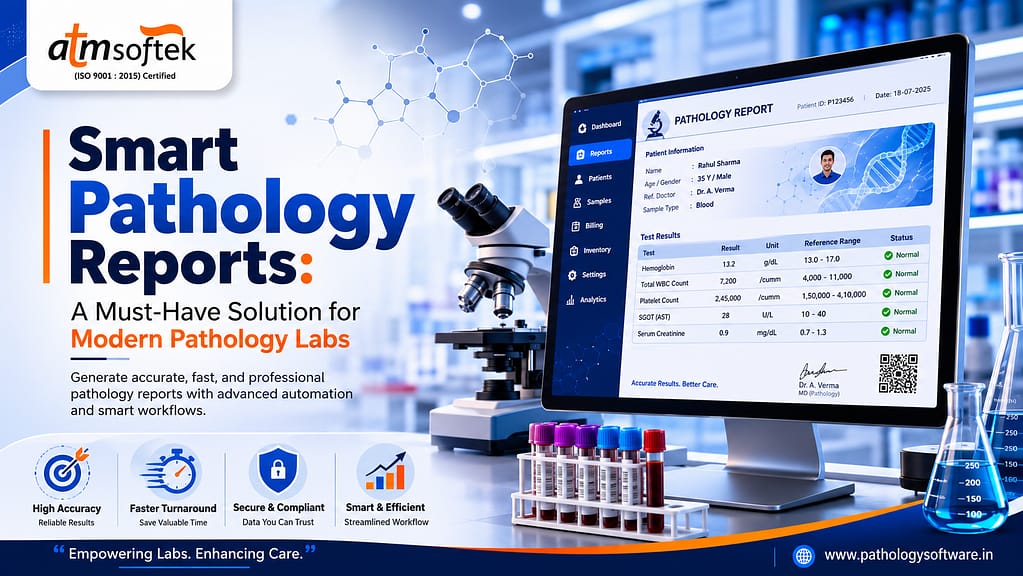
At their core, Smart Pathology Reports are digitally generated, template-driven diagnostic reports that combine structured data entry, automated calculations, built-in reference ranges, and instant formatting into a single streamlined workflow. Unlike traditional reports typed manually in a word processor, smart reports are produced through a smart lab reporting system that pulls data directly from analyzers, applies validation rules, and auto-populates report templates.
As a result, technologists spend far less time on repetitive data entry, and pathologists can focus on interpretation rather than formatting. This shift is not simply cosmetic; it fundamentally changes how quickly and how reliably a lab can move a sample from collection to a finished, physician-ready report.
Digital pathology reporting is no longer an optional upgrade — it has become a baseline expectation. Patients now routinely access digital lab reports through patient portals or mobile apps, and referring doctors expect reports that are legible, structured, and easy to compare against previous results. Consequently, labs still relying on manual transcription or fragmented spreadsheets are at a growing competitive disadvantage.
Furthermore, digital pathology reporting integrates naturally with a laboratory information management system (LIMS), allowing sample tracking, quality control, and report generation to happen within one connected environment. This integration reduces duplicate data entry, minimizes transcription errors, and creates a single source of truth for every test performed.
In addition, regulatory and accreditation bodies increasingly expect standardized, auditable documentation. Automated pathology reports make it far easier to maintain the consistency and traceability that accreditation frameworks such as NABL demand, since every field, calculation, and reference range follows a validated template rather than an individual technician’s formatting habits.
Choosing the right pathology report software delivers measurable improvements across accuracy, speed, and staff productivity. The most significant benefits include:
Faster turnaround time: automated data capture and pre-built templates eliminate hours of manual formatting each day.
Reduced human error: built-in validation rules and reference ranges catch inconsistencies before a report reaches a physician.
Consistent branding and formatting: every report follows the same professional layout, regardless of which technologist generates it.
Seamless analyzer integration: results flow directly from diagnostic instruments into the report, reducing transcription risk.
Simplified compliance: standardized templates support NABL and ISO documentation requirements with far less manual effort.
Better patient experience: quicker delivery of digital lab reports through portals, WhatsApp, or email improves patient satisfaction.
Taken together, these benefits explain why forward-thinking laboratory reporting software is increasingly viewed not as a convenience, but as core infrastructure for any serious diagnostic lab software strategy.
Not every pathology software for laboratories delivers the same value. When evaluating a smart lab reporting system, decision-makers should prioritize a few essential capabilities. First, the platform should offer flexible, specialty-specific templates, since a hematology report and a histopathology report require very different structures. Second, it should support bidirectional integration with analyzers and, ideally, with a broader pathology lab management software suite covering billing, inventory, and patient records.
Additionally, security matters enormously; look for role-based access controls, audit trails, and encrypted data storage. Finally, scalability is essential — the system should perform equally well for a single-branch diagnostic center and a multi-location laboratory network handling thousands of samples per day.
Among the providers building this next generation of diagnostic technology, ATM Softek has emerged as a genuine torchbearer in advancing digital pathology reporting. As an ISO 9001:2015 certified healthcare SaaS company, ATM Softek has spent years refining pathology, HMS, polyclinic, eye care, IVF, and veterinary management systems for real-world laboratory environments — not built as an afterthought bolted onto generic hospital software.
Today, ATM Softek’s solutions serve more than 6,000 clients across 21 Indian states, and its flagship reporting module reflects that depth of experience. Rather than offering a one-size-fits-all report generator, ATM Softek has engineered its platform around the actual daily workflow of Indian diagnostic labs: rapid analyzer integration, specialty-specific templates, automatic reference-range flagging, and instant delivery of digital lab reports to patients and referring doctors alike.
Moreover, ATM Softek’s approach to pathology lab management software goes beyond report generation alone. The platform connects reporting with sample tracking, billing, inventory, and a full laboratory information management system (LIMS), so that labs are not forced to stitch together multiple disconnected tools. This unified architecture is precisely what makes ATM Softek stand out as an innovator rather than simply another vendor of automated pathology reports.
Ultimately, ATM Softek’s commitment to continuous product refinement, hands-on client support, and deep domain expertise in Indian healthcare diagnostics is what has established the company as an industry leader in smart pathology report solutions — a trusted technology partner for labs that want to modernize without compromising reliability.
Transitioning from manual or semi-digital reporting to a fully smart lab reporting system can feel daunting, but the return on investment is substantial. Labs that adopt modern pathology report software typically see faster turnaround times, fewer corrections, happier referring physicians, and a noticeably lighter administrative burden on technologists and pathologists alike.
Therefore, if your laboratory is still relying on manual formatting or disconnected reporting tools, now is the right time to evaluate a genuine digital pathology reporting solution. A well-designed platform will not only streamline day-to-day operations but also position your lab for long-term growth as diagnostic volumes and patient expectations continue to rise.
Smart pathology reports are digitally generated diagnostic reports created through automated software rather than manual typing. They pull data directly from lab analyzers, apply pre-built templates and reference ranges, and produce a standardized, physician-ready report with minimal manual intervention.
Pathology report software reduces repetitive data entry, minimizes transcription errors, and speeds up turnaround time by automating formatting and validation. It also integrates with analyzers and broader lab management systems, allowing technologists and pathologists to focus on accuracy and interpretation instead of manual paperwork.
Digital pathology reporting supports faster, more consistent, and more secure delivery of results. It aligns with patient expectations for digital lab reports, simplifies compliance with accreditation standards, and integrates smoothly with a laboratory information management system, creating a single, reliable source of diagnostic data.