
April 10, 2026
Modern diagnostic laboratories operate under growing pressure — higher test volumes, tighter turnaround expectations, and stricter regulatory oversight. Manual, paper-driven processes can no longer keep pace. So, they automate pathology lab workflow and address this directly by replacing fragmented, error-prone tasks with integrated digital systems that track samples, capture results, generate reports, and manage compliance automatically.
Laboratory workflow management software covers the full operational cycle: patient registration, sample tracking, instrument interfacing, result validation, report dispatch, and billing. For pathology lab managers and IT decision-makers evaluating their options in 2026, understanding what automation delivers — and how to choose the right platform — is essential.
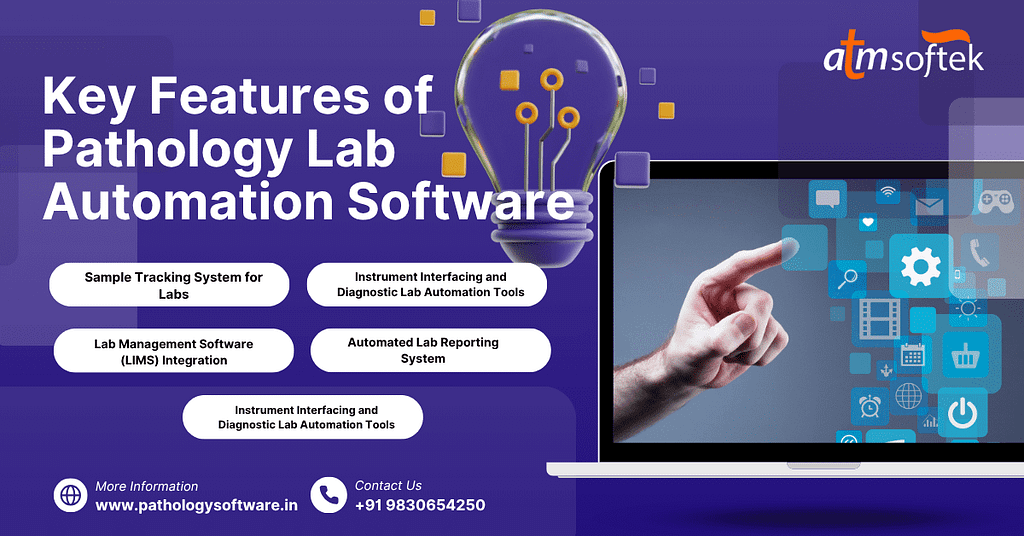
A sample tracking system assigns barcodes or QR codes at the point of collection and follows the sample through every processing stage. Lab staff and managers gain real-time visibility into sample location and status, automated alerts for delays, and a complete audit trail — a requirement under NABL and ISO 15189 accreditation.
Diagnostic lab automation tools connect directly to analysers and diagnostic equipment, capturing results automatically without manual entry. This eliminates transcription errors, flags abnormal values for immediate attention, and reduces the time between analysis and reporting.
A laboratory information management system (LIMS) acts as the central data repository for all patient records, test parameters, and results. Effective pathology lab automation software integrates with LIMS natively — enabling two-way data exchange, role-based access control, and connectivity with hospital information systems (HIS) and EMR platforms.
An automated lab reporting system generates branded, clinician-approved reports the moment results are validated — dispatching them via email, SMS, or WhatsApp without manual handling. This cuts average report turnaround time significantly and removes a common source of administrative bottlenecks.
Lab data management software consolidates historical records and presents operational KPIs — test volumes, TAT trends, equipment utilisation, and revenue performance — through a centralised dashboard. These insights support better resource planning and quality improvement decisions.
Adopting laboratory workflow management software delivers measurable gains across three dimensions:
Two deployment models dominate the laboratory workflow management software market. Cloud-based platforms offer lower upfront cost, automatic updates, and remote accessibility — ideal for growing labs and multi-branch networks. On-premise deployments give greater data sovereignty and suit facilities with strict data residency requirements or limited internet reliability. In 2026, hybrid architectures are increasingly common, combining cloud accessibility with on-premise data storage.
Evaluate any platform on four criteria before committing:
Request a live demonstration using your lab’s actual test types and volumes. Speak to reference customers in similar facilities before making a final decision.
ATMSoftek is a Kolkata-based healthcare technology company specializing in pathology lab software solutions built specifically for the Indian diagnostic market. Their platform covers the complete workflow — sample tracking, instrument interfacing, LIMS integration, automated reporting, billing, inventory management, and multi-branch administration — in a single, unified system.
Key capabilities of ATMSoftek’s pathology lab automation software include:
ATMSoftek provides full implementation support, on-site and remote training, and ongoing technical assistance—ensuring labs are operational quickly and supported reliably over time.
Three trends are shaping the next phase of pathology lab workflow automation. First, AI and machine learning are being integrated into diagnostic lab automation tools to assist in image analysis, predict TAT deviations, and flag QC anomalies before they affect reports. Second, cloud adoption is accelerating — more labs are moving to cloud-based laboratory workflow management software to support remote pathologist access and distributed operations. Third, patient-facing digital delivery is maturing: report portals, mobile apps, and structured result APIs are replacing static PDF dispatch as the standard for an automated lab reporting system.
| What is pathology lab workflow automation? It is the use of integrated software—including LIMS, sample tracking systems, and automated reporting tools — to digitize and streamline every stage of lab operations, from patient registration through billing and compliance reporting. |
| How does pathology lab automation software improve accuracy?By eliminating manual data entry through direct instrument interfacing, validating results automatically, and routing exceptions for review before dispatch — reducing transcription errors and sample misidentification. |
| Can pathology lab automation software integrate with an existing LIMS? Yes. Leading platforms, including ATMSoftek’s, use open API architectures to connect with existing laboratory information management systems, HIS, EMR, and diagnostic equipment interfaces. |
| What makes ATMSoftek’s solution stand out? ATMSoftek’s platform is purpose-built for Indian diagnostic labs, with native support for NABL compliance, GST billing, multi-branch management, and direct analyzer interfacing—backed by dedicated implementation and ongoing support. |
Pathology lab workflow automation is now a baseline requirement for diagnostic labs that need to remain accurate, compliant, and competitive. From sample tracking and instrument interfacing to automated reporting and analytics, laboratory workflow management software eliminates the inefficiencies that hold manual operations back.
ATMSoftek’s pathology lab automation software gives Indian diagnostic labs a proven, scalable platform to modernise operations, meet regulatory requirements, and deliver faster, more reliable results to patients and physicians. To arrange a demonstration, contact ATMSoftek using the details below.
ATMSoftek — Enterprise-grade pathology lab software solutions for modern healthcare centres.
| Head Office15th Floor, EM4, EM Block, Ambuja Neotia Eco Center,Bidhan Nagar, North 24 Parganas, West Bengal 700091 | Branch OfficeWebel IT Park Kalyani, Module 201,Kalyani, Nadia, West Bengal 741235 (Near Buddha Park More) | |
| Emailinfo@pathologysoftware.in | Phone08334 075584 / 98306 54250 | Webwww.atmsoftek.in |
Follow Us: Facebook | LinkedIn | Instagram | Twitter/X | YouTube